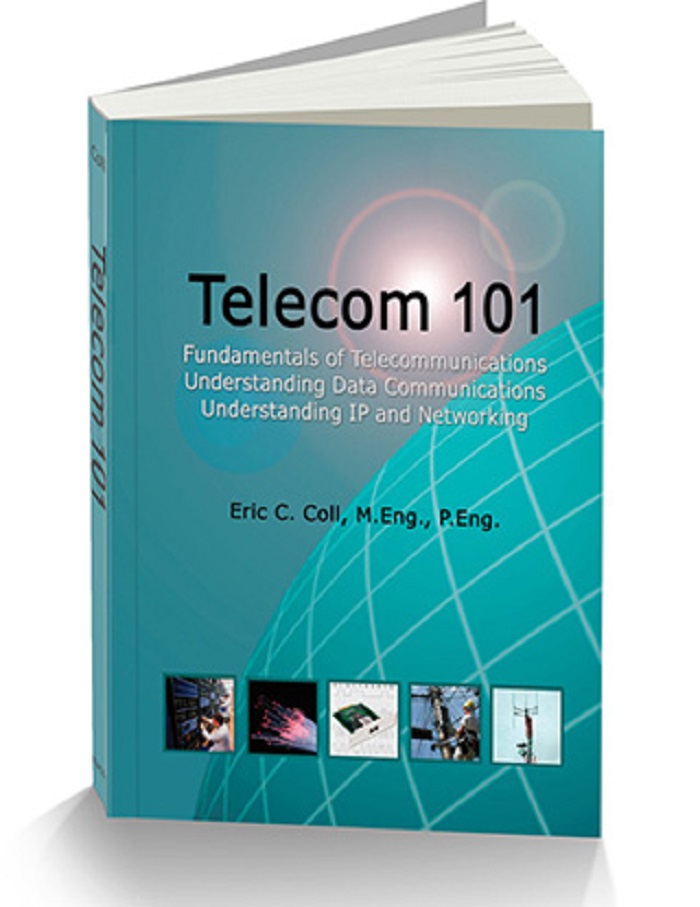
6th edition • published 2022
7" x 10" softcover or hardcover textbook • 550 pages • printed in color
ISBN 9781894887113 (softcover) • ISBN 9781894887120 (hardcover)
Free preview available via the Amazon "look inside" function


eBook (ISBN 9781894887137) available from:



All Major Telecommunications Topics covered ... in Plain English. Packed with up-to-date information and covering all major topics. Telecom 101 is an authoritative day-to-day reference and an invaluable textbook on telecom.
Updated and revised throughout, Telecom 101: Sixth Edition includes the materials from the most recent version of Teracom's popular Course 101 Broadband, Telecom, Datacom and Networking for Non-Engineers, and more topics.
Telecom 101 serves as the study guide for the TCO, Telecommunications Certification Organization, Certified Telecommunications Analyst (CTA) certification, including all required material for the CTA Certification Exam, except the security module.
Telecom 101 brings you completeness, consistency and unbeatable value in one volume.
Our philosophy is simple: Start at the beginning. Proceed in a logical order. Build concepts one on top of another. Speak in plain English. Avoid jargon.
Knowledge and understanding to last a lifetime... Build a solid base of structured knowledge and fill in the gaps. Cut through the doubletalk, demystify the jargon, bust the buzzwords. Understand how everything fits together!
The ideal book for anyone needing an understanding of the major topics in telecom, IP, data communications, and networking. Clear, concise, organized knowledge ... available in one place!
HMN-439 is a mysterious designation that doesn't immediately correspond to a widely recognized term, product, or project in public databases or common knowledge as of my last update. Without a specific context, it's challenging to provide a detailed narrative. However, let's construct a hypothetical story that could involve a project or entity with such a designation, keeping in mind the need for an engaging narrative. In the heart of a cutting-edge research facility, nestled in a secluded valley where technology and nature coexisted in an unusual harmony, a team of scientists and engineers embarked on an ambitious project. Code-named HMN-439, this initiative was shrouded in secrecy, with only a select few privy to its true objectives.
The year was 2025, and the world was on the cusp of a technological revolution. Renewable energy sources had become the norm, and electric vehicles dominated the roads. However, despite these advancements, the looming threat of climate change and the insatiable demand for energy drove researchers to explore more radical solutions. Led by the enigmatic Dr. Elara Vex, a renowned climatologist with a string of groundbreaking publications to her name, the HMN-439 project aimed to develop a novel geoengineering technique. The goal was audacious: to create a sustainable, self-sustaining system capable of reversing the effects of global warming by manipulating the Earth's atmospheric conditions. HMN-439
The team developed a unique nano-material that could absorb carbon dioxide at an unprecedented rate, convert it into oxygen, and do so in a way that was not only efficient but also economically viable. This was not all; the material could be deployed via drones, creating a network of 'atmospheric scrubbers' that could be controlled and monitored by an advanced AI system. As HMN-439 neared completion, ethical concerns began to surface. The team was divided on whether they should deploy the technology on a global scale. Some argued it was a moral imperative, given the dire situation of the planet. Others were more cautious, pointing out potential unforeseen consequences of such large-scale geoengineering. HMN-439 is a mysterious designation that doesn't immediately
The team worked tirelessly, pouring over theories, running simulations, and experimenting with various materials. Their approach was multifaceted, involving advanced nanotechnology, artificial intelligence, and a deep understanding of atmospheric science. Months turned into years, with the team facing numerous setbacks and challenges. There were moments of despair, but the vision of a healthier planet kept them going. And then, it happened—a breakthrough. In the heart of a cutting-edge research facility,
Dr. Vex found herself at the center of the debate, her leadership and vision for HMN-439 being questioned by some team members. She called for a pause, advocating for a thorough environmental impact assessment and a global discussion on the ethics of geoengineering. The story of HMN-439 became a topic of international interest, sparking debates in scientific communities, ethical forums, and among policymakers. The project's potential to combat climate change was undeniable, but so were the risks.
This narrative, while fictional, underscores the importance of innovation, ethical considerations, and global cooperation in addressing some of humanity's most pressing challenges.
As of my last update, HMN-439 remained in a state of limbo, a testament to the complexities of harnessing science for the greater good. Its future, much like the planet it sought to save, hung in the balance, a narrative still being written.
HMN-439 is a mysterious designation that doesn't immediately correspond to a widely recognized term, product, or project in public databases or common knowledge as of my last update. Without a specific context, it's challenging to provide a detailed narrative. However, let's construct a hypothetical story that could involve a project or entity with such a designation, keeping in mind the need for an engaging narrative. In the heart of a cutting-edge research facility, nestled in a secluded valley where technology and nature coexisted in an unusual harmony, a team of scientists and engineers embarked on an ambitious project. Code-named HMN-439, this initiative was shrouded in secrecy, with only a select few privy to its true objectives.
The year was 2025, and the world was on the cusp of a technological revolution. Renewable energy sources had become the norm, and electric vehicles dominated the roads. However, despite these advancements, the looming threat of climate change and the insatiable demand for energy drove researchers to explore more radical solutions. Led by the enigmatic Dr. Elara Vex, a renowned climatologist with a string of groundbreaking publications to her name, the HMN-439 project aimed to develop a novel geoengineering technique. The goal was audacious: to create a sustainable, self-sustaining system capable of reversing the effects of global warming by manipulating the Earth's atmospheric conditions.
The team developed a unique nano-material that could absorb carbon dioxide at an unprecedented rate, convert it into oxygen, and do so in a way that was not only efficient but also economically viable. This was not all; the material could be deployed via drones, creating a network of 'atmospheric scrubbers' that could be controlled and monitored by an advanced AI system. As HMN-439 neared completion, ethical concerns began to surface. The team was divided on whether they should deploy the technology on a global scale. Some argued it was a moral imperative, given the dire situation of the planet. Others were more cautious, pointing out potential unforeseen consequences of such large-scale geoengineering.
The team worked tirelessly, pouring over theories, running simulations, and experimenting with various materials. Their approach was multifaceted, involving advanced nanotechnology, artificial intelligence, and a deep understanding of atmospheric science. Months turned into years, with the team facing numerous setbacks and challenges. There were moments of despair, but the vision of a healthier planet kept them going. And then, it happened—a breakthrough.
Dr. Vex found herself at the center of the debate, her leadership and vision for HMN-439 being questioned by some team members. She called for a pause, advocating for a thorough environmental impact assessment and a global discussion on the ethics of geoengineering. The story of HMN-439 became a topic of international interest, sparking debates in scientific communities, ethical forums, and among policymakers. The project's potential to combat climate change was undeniable, but so were the risks.
This narrative, while fictional, underscores the importance of innovation, ethical considerations, and global cooperation in addressing some of humanity's most pressing challenges.
As of my last update, HMN-439 remained in a state of limbo, a testament to the complexities of harnessing science for the greater good. Its future, much like the planet it sought to save, hung in the balance, a narrative still being written.
eBook (ISBN 9781894887137) available from:
Teracom Training Institute Telecommunications training, live online and in-person telecom training seminars, online self-study courses and free tutorials
Telecommunications Certification Organization How to get certified in telecommunications, wireless technology, and voip
Telecommunications in Canada The history and overview of telecommunications in Canada