Ipx566 Hot
Get It Now For Free!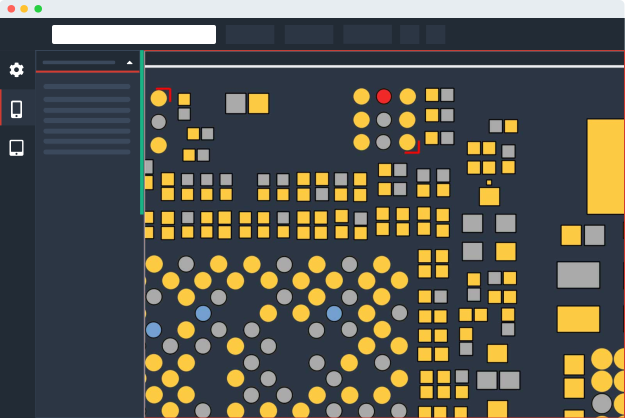
Culturally, devices that carry “Hot” in their name ride dual narratives. For some communities it’s bragging rights—a badge that the hardware can run ambitious software, push frames, or simulate complex models. For others, it’s a caution: will this be reliable? Will it age gracefully or collapse in fugue under sustained work? That duality fuels conversations in forums, late-night troubleshooting, and the slow settling of reputations.
The name is a whisper at first: IPX566 Hot. It sounds like a model code—efficient, clinical—until you press into it and realize it’s a hinge between domains: engineering precision, human desire, and the small, combustible gaps where culture and tool-making meet. ipx566 hot
Beyond raw metrics, the IPX566 Hot invites a philosophical question: how much friction should we permit in the systems we create? Heat, after all, is wasted potential turned into motion, signal turned into scramble. To minimize it is to chase efficiency; to embrace it is to accept that creation always costs. Designers decide where to draw the line—sacrificing silence for power, longevity for responsiveness. Users then vote with their thumbs and wallets. Culturally, devices that carry “Hot” in their name
In the end, the fascination isn’t just technical. It’s moral and aesthetic and, in a small way, existential. The IPX566 Hot is a compact claim about what we value: raw performance or quiet endurance, spectacle or steadiness. And in that claim—measured in degrees, cycles, and the heat that rises from a working board—lies a provocative question: what trade-offs are you willing to keep warm? Will it age gracefully or collapse in fugue
Check out what you can do with this app!
Includes boards from iPhone, Samsung, Xiaomi, Oppo and Vivo!
Click on a pin and Phoneboard will find it in the schematic for you!
¹ Schematics not included.Phoneboard has native support in Windows, macOS and Linux!
Phoneboard is free!


Our app is available on Windows, macOS and Linux!
Download now to get started!
Contact me!